Co-design Hub
On This Page
What is co-design?
Co-design is a way of including people with lived experience in designing programs and policies and shaping their outcomes. It is being used more often by governments, service providers and organisations – including CYDA – in Australia and around the world.
It is done differently by different people because there is no single definition, framework or set of principles. As a result, the quality and standards for co-design can vary a lot, and it is not always done well.
To be meaningful, co-design needs to go beyond just having people with lived experience in the room.
Good co-design allows for meaningful and authentic participation from everyone. That means genuinely involving people with lived experience at every stage of a project, giving them the power to make decisions, and respecting their rights and autonomy.
Every individual and organisation that uses co-design should strive to make sure it is genuine in this way.
Our research
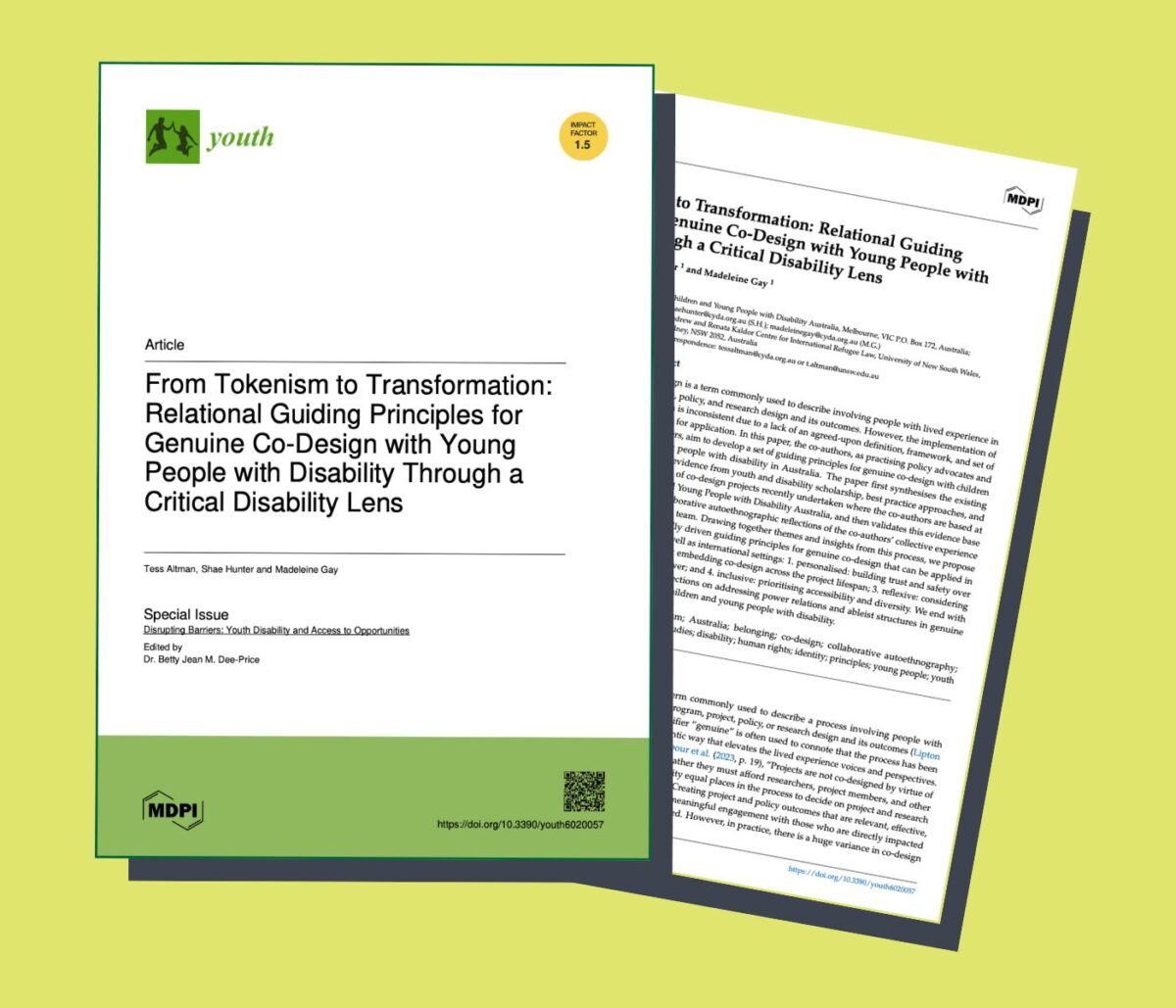
In 2026, CYDA published an evidence-based article on how to run genuine co-design in the open-access journal Youth.
Developed by members of our Policy and Research team, it creates a set of guiding principles for genuine co-design.
Read the full article or a summary by clicking below
Four Key Principles for good co-design
CYDA’s four key guiding principles for genuine co-design are based on Australian evidence and research.
They draw from youth and disability academic literature, best practice approaches from industry leaders, case studies from CYDA’s own co-design projects, and the lived and professional experience of our policy and research team.
These principles can – and should – be used by anyone involved in co-design with children and young people with disability. From researchers and policymakers to the practitioners running co-design.
Principle 1: Apply a personalised approach to foster trust and safety
Genuine co-design is possible when it is safe, transparent, consistent, and based on a strong relationship with everyone involved.
- Take the time to build strong, respectful and two-way relationships
- Support people's safety by respecting privacy and providing well-being support
- Be transparent about the process and outcomes, including who makes decisions
- Be consistent and reliable
Principle 2: Take a holistic approach that considers the whole project lifespan
To be meaningful, co-design needs to play a role throughout a project, not just at the start or end.
- Include co-design at different stages of the project with flexible and well-resource planning and preparation
- Recognise from the start that letting the project develop slowly can be an important way to challenge ableist work practices
- Make changes to the project based on co-designer suggestions and feedback, and make sure co-designers are aware of these changes
Principle 3: Undertake a reflexive approach to power and agency
Everyone involved in co-design should have a fair say, but making this happen requires being open about existing power differences.
- Get everyone to question their own position and background, and how much power they have to make decisions
- Provide opportunities to sit in the discomfort this creates
- Use power mapping tools throughout the project
- Create ways for everyone in the project team to learn and build their skills
- Provide opportunities for co-designers to lead research, create and make decisions
Principle 4: Ensure an inclusive approach to accessibility and diversity
Last but not least, authentic co-design is accessible and diverse, allowing everyone to take part.
- Provide accessible materials and formats for all co-designers
- Use clear communication
- Make sure people from diverse background and experiences can take part
- Recognise the impacts of intersectionality and how people can face multiple barriers based on their identity and experience
- Use creative and interactive methods
- Use flexible timings and approaches that respect different needs and preferences
Additional co-design resources
Coming soon.
CYDA's co-design project work
Co-design is used regularly as part of CYDA’s advocacy work. The following projects have involved significant co-design with and for children and young people with disability, and their parents or caregivers.
Click on each icon to learn more